
The CAM Academy Trust is a charitable company limited by guarantee and has a number of layers of governance: the Members, Board of Trustees, Local Advisory Boards and the Executive Team.
The Scheme of Delegation is a key document defining how accountability and decision-making works within the Trust. As a document, the Scheme of Delegation is a simple and systematic way of ensuring Members, Trustees, Board committees, executive leaders, principals are clear about their roles and responsibilities within the governance structure.
Our governance structure ensures that there are clear reporting lines and explicit requirements to ensure probity, good governance and outstanding performance.
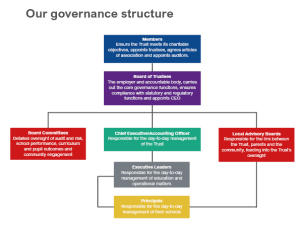
The members of the trust ensure that the board of trustees have the necessary expertise to fulfil its functions effectively and that the board acts in accordance with the trust’s charitable objects.
Members are responsible for determining the governance of the trust. While the members hold the board of trustees to account for the effective governance of the Trust, the members themselves have a minimal role in the actual running of the Trust. It is the board of trustees, not the members, who are the organisation’s key decision makers.
The members approve our Articles of Association. The Articles of Association, as agreed with the Department for Education, set out the details for our internal management, decision making and running of the trust. One of the Members’ key responsibilities is the appointment of Trustees, in accordance with the Articles.
The trustees are both charity trustees and company directors. The trust is the legal entity with the board having collective accountability and responsibility for the academy trust and assuring itself that there is compliance with regulatory, contractual, and statutory requirements.
The Board of Trustees provide:
· Strategic leadership of the trust: the board defines the trust vision for high quality and inclusive education in line with its charitable objects. It establishes and fosters the trust’s culture and sets and champions the trust strategy including determining what, if any, governance functions are delegated to the local tier.
· Accountability and assurance: the board has robust effective oversight of the operations and performance of the trust, including the provision of education, pupil welfare, overseeing and ensuring appropriate use of funding and effective financial performance and keeping their estate safe and well-maintained.
· Engagement: the board has strategic oversight of relationships with stakeholders. The board involves parents, schools and communities so that decision-making is supported by meaningful engagement.
Trustees meet as a Board of Trustees four times a year, and sub- committees, including Audit & Risk, Curriculum & Standards, Community & Partnerships and Governance and Remuneration.
Local Advisory Boards are sub-committees of the trust board and monitor safeguarding practices, SEND, school performance and engage with stakeholders, ensuring stakeholder views are accounted for and reflected in Trust Board decisions. To comply with the articles of association two parents are elected to the individual academy committees.
Formulation of strategy and day to day operations are delegated to the Chief Executive. The Chief Executive is supported by an executive leadership team and professional experts within the trust central team.
The Principals are responsible for the day-to-day management of the individual schools. The Principals share information with the LAB about how the school operates to enable monitoring and scrutiny of key procedures and improvement plans.